

Parking fights feel intensely local, but they’re almost never unique. Different block, same script. Residents worry about spillover. New housing gets blamed. Meetings get heated. And somehow, nothing ever feels resolved.
The problem is that parking debates usually start in the wrong place.
Subscribe to the Newsletter
This was originally posted as Expedition Log no. 41: Why Parking Debates Never Go Away on 12 January, 2026 as part of my weekly-ish newsletter, and is here to make it easy to link to.
the problem
Parking First, Housing Second
Most cities still treat parking as a required accessory to housing rather than a managed public resource. Minimum parking requirements assume a fixed level of car ownership, and assumes that everyone needs to use a car to move about.
Housing approvals often hinge on whether those minimums are met. Meanwhile, curb space is free or underpriced, with demand fluctuating by time of day, and enforcement is inconsistent.
The result is a system where supply is regulated as if it’s static, while demand behaves dynamically. Housing gets evaluated through a parking lens that doesn’t reflect how streets actually work.
the pattern
It’s about anxiety
Because the system doesn’t adapt, the same conflict repeats itself everywhere.
New building proposed → fears of parking loss → calls for more off-street parking → higher construction costs → fewer units or delayed projects → curb congestion remains unsolved.
From the outside, it looks like neighbors opposing growth. From inside the system, it’s more accurate to say that parking is about people’s anxieties about change because it’s the most visible stress point. When parking feels scarce, everything else feels like a threat.
That’s why even modest projects trigger outsized reactions. The fight isn’t really about one building. It’s about a system that offers no way to manage demand transparently.
the tradeoffs
Society versus the individual
Parking policy always involves tradeoffs, whether they’re acknowledged or not.
- More required parking means higher construction costs and fewer homes.
- Less required parking can increase short-term competition for curb space.
- Free curb parking feels equitable, but often benefits a small subset of residents disproportionately.
- Pricing and permits can manage demand, but they require political will and administrative follow-through.
There is no parking solution that makes everyone happy. But pretending those tradeoffs don’t exist just guarantees the argument will come back again.

solutions
No Mandatory Parking
If cities want parking debates to stop hijacking housing conversations, the lever isn’t arguing harder: it’s decoupling parking from housing approvals.
Parking minimums are wrong, immoral, and create bad neighborhoods.
That means:
- Allow walkable and bikeable communities where cars are optional. We used to build theses communities, then we literally outlawed them. It’s time to go back.
- Evaluating housing on housing merits, not parking merits
- Managing curb space directly, with pricing, permits, or time limits
- Treating parking demand as something to be managed over time, not predicted perfectly upfront
- When parking is handled as its own system, it stops distorting every other decision.

If I was King of Zoning, I would mandate the following:
Hypothetical reader, you might be asking: so…Randy, if this is so easy, what are your policy proposals?
Great question reader!
If you want to decenter the car, allow people the freedom of movement which doesn’t require spending an increasingly large amount of money on a car, and you want energy independence so we don’t have to worry about what some Middle Eastern country is doing, then building walkable neighborhoods are key.
And we can start piecemeal! It doesn’t need a command economy to make it happen! Just re-legalizing what was already allowed 100 years ago would be fine.
My list is:
- As of Right Zoning
- Mixed Use by Default
- No Parking Minimums
- Abolish Single Family Only Zoning
- Diverse Housing Types
- More Ownership Models
- Transit Housing Bonus
- Car-free neighborhoods
- Public & Social Housing Everywhere
- No Setbacks
- LISTEN TO THIS EPISODE:
- Apple Podcasts
- Spotify
evidence
- Minneapolis (2021)
Eliminated parking minimums citywide
Result: Developers now build parking based on actual demand; housing projects face fewer cost and approval barriers. - Buffalo (2017)
Eliminated parking minimums via the Green Code
Result: Adaptive reuse and small-scale infill became easier by removing a common blocker for older buildings. - San José (2022)
Removed parking minimums for most land uses
Result: Parking supply now varies by location and transit access, without citywide parking disruption. - Portland (2022)
Eliminated parking minimums near frequent transit and for many residential uses
Result: More housing projects pencil out while still allowing parking where the market supports it. - Austin (2023)
Eliminated parking minimums citywide
Result: Housing approvals face fewer procedural delays tied to parking compliance, improving predictability.
language to borrow
It’s spatial
“This is a geometry, pricing, and design problem.”
That sentence reframes the problem without dismissing people’s anxiety.Reframing is often the most powerful policy move available.

A conversation about cities, architecture, history, and why these affect us today. Hosted by Randy Plemel and a weekly cast of characters.
Subscribe via Apple Podcasts, Spotify, or Feed

A conversation about cities, architecture, history, and why these affect us today. Hosted by Randy Plemel and a weekly cast of characters.
How do you redesign one of the most beloved streets in television history—without losing its soul? Scenic designer David Gallo takes us behind the scenes of his work refreshing Sesame Street, balancing history with modern storytelling.

typology.city

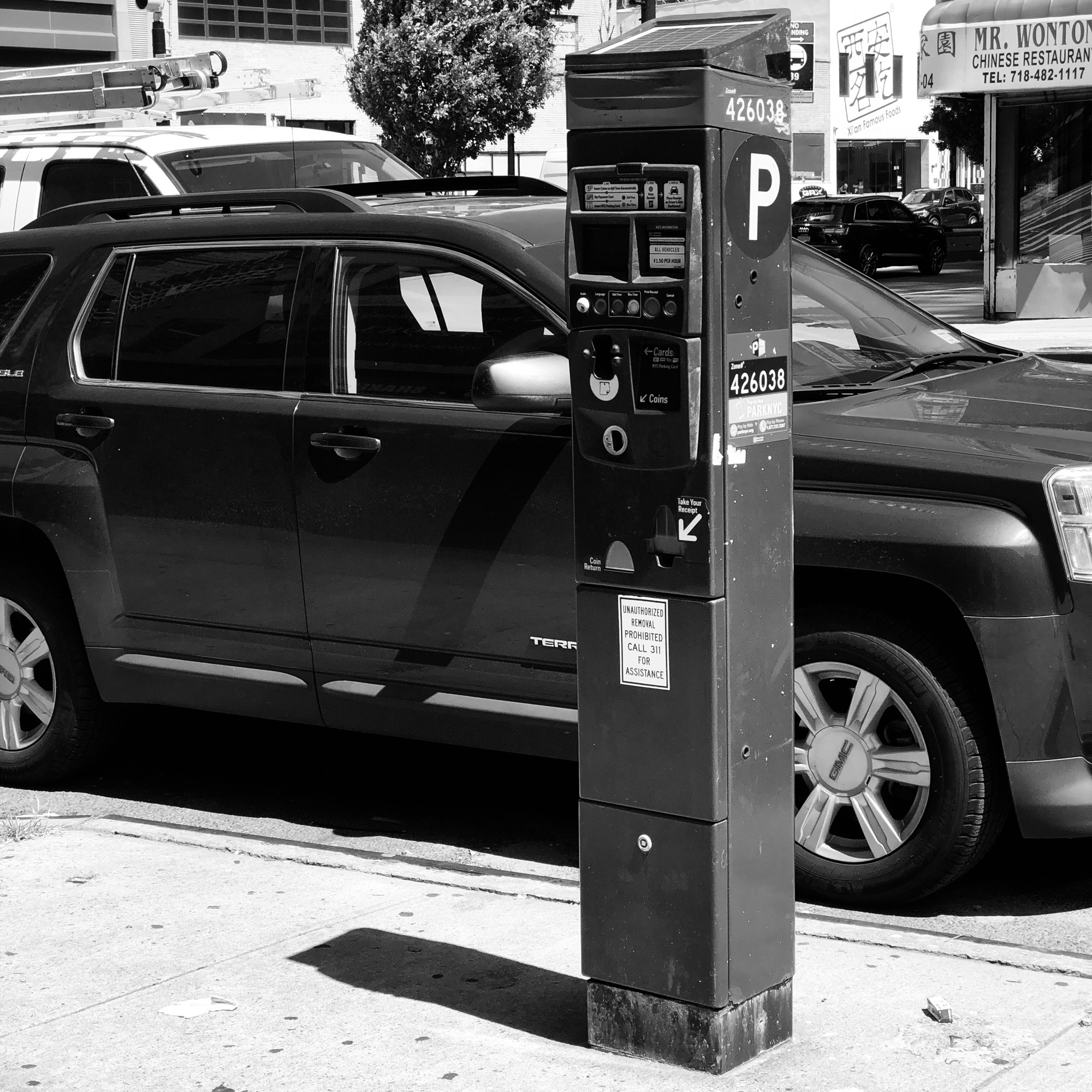
Parking Payment Kiosk
disputatio statio
Parking Payment Kiosk are electronic meters that facilitate payment for metered parking spaces in New York City.
Over time, the system has evolved from mechanical coin-operated Parking Meters to Pay-And-Display meters, which use a printed receipt, to Pay-By-Plate meters, which store payment information digitally using the vehicle’s license plate number.
Subspecies variations
We’ve observed two active distinct subspecies (with the mechanical parking meter being extinct) which are important to call out:
- disputatio statio ostendo
Pay-And-Display Meter - disputatio statio tabula
Pay-By-Plate Meter